Jin Pyn's harrowing escape from being gnawed and trampled to death by a protective elephant mother.
But because she's seen both sides of the animal, she respects it even more for what it truly is - a wild, magnificent and intelligent animal.
Hear her story on FM93.8
http://www.podcast.com.sg/rsi_english/
ttales/070416_ttales_elephant.mp3
Showing posts with label Jin Pyn. Show all posts
Showing posts with label Jin Pyn. Show all posts
Thursday, April 19, 2007
iSh, The Elephant and the Tree and Hans Christian Anderson's classics
iSh 8.1 p94-97
Special feature on Jin Pyn and The Elephant and the Tree. The Elephant and the Tree is compared to Hans Christian Anderson's classics. What an honour! Jin Pyn's philosophy is also associated with that behind the other famous classic - Winne the Pooh.
(Pardon the bad scans. The scanner is old and mouldy. Go get a copy of iSh!)


Text:
Congratulations on having your first title! No doubt the route must have been long and dusty. Tell us more about how the project started and the difficulties you met.
Thanks! I got wind of the opportunity from my cousin and a friend. The Elephant had been gestating in my mind for a while now, and so the birth of The Elephant and the Tree was quick in Cambodia, where I was staying at that time. Thank goodness for Cambodia’s hand-courier services! The manuscript would not have reached the National Book Development Council (NBDCS) in time otherwise! That was the easy part.
As this was my first publishing project, everything else was a case of swimming in murky waters. Guidebooks helped, but they were mostly for aspiring authors who want to pitch to publisher, and not about publishing. Good thing was, there were many helpful people, most of whom weren’t even my friends to begin with.
Aside from The Elephant And The Tree, Singapore Media Fusion 2005 also unearthed other children’s books. How else can the government or local institutions encourage the scene?
International publishers based here and local publishers can publish works from such schemes since the work would have already been validated. Suppliers can support the project through full or partial sponsorship. Big corporations can adopt a title/ artist by committing to buy the finished work, or a certain number of copies; better still, donate the purchases to needy children. They will also benefit from the publicity arranged for the scheme.
I must say that retailers have been largely supportive of local authors. Many give prime spots to local writers; and some, like Page One, actively promote local works.
Aside from funding, the government can help with publicity, which is extremely crucial for debut writers. On exporting the works, Media Development Authority was indispensable in exhibiting the Singapore children’s titles at the Frankfurt Book Fair. Hopefully they will do the same for the Bologna Children’s Book Fair! The non-profit National Book Development Council of Singapore has also done a tremendous job in initiating publishing schemes and publicising local authors, but perhaps more awards and website reviews in the literary scene can be set-up, such as those in the UK and USA, many of which are internationally recognised but are meant only for the respective countries’ own published titles and authors. Apart from helping to push local talent into international limelight, parents rely greatly on these reviews and awards in their selection of books for their children.
What differentiates you from other Singaporean writers and illustrators?
There isn’t much to compare. The Elephant and the Tree is a fable and a children’s picture book. A fable or a children’s picture book tends to be more universal in content, rather than being culturally specific. A great deal of content from local writers do however, centre on Singapore and their sense of identity as Singaporean.
What was the most important lesson you walked away with from your English Literature classes in National University of Singapore? How did you apply it to your writing?
That I can manage not to read my books and still get away with it? Couldn’t apply that to my writing though. Jokes aside ¬- rhythm, syntax, alliteration, imagery, and symbolism. Although a children’s picture book is written in prose, it is, in many ways, like poetry. By its nature, the story has to be succinct, carry rhythm when read out loud, and retain sensitivity in its syntax. For a good children’s picture book, that syntax also interacts with the illustrations. This means a greater thought process, more creativity and discipline! To say more by saying less is more difficult!
Tell us more about the natural history filmmaking course you were selected for. How was the selection carried out? How long was the stint? What did the stint comprise?
The course was part of Animal Planet’s original series and biggest production Unearthed, which will be aired in April 2007. Applicants had to send a short self-introduction reel. The reels were used to judge our creativity and groundings in natural history filmmaking. As this was a course, the most important criterion was passion for the subject. I have been volunteering for various animal welfare and environmental groups, such as ACRES, and WildAid Asia, even chairing one in the university.
Only six were selected from the international applications. We spent a month at the Shamwari Private Game Reserve in South Africa. It was one of the most well-run and ethical game reserves I have visited. We were taught how to put together a natural history documentary, such as budgeting, researching, pitching and camerawork. Everyday we filmed one type of animal: elephants, lions, cheetahs; and we had only a day to cut a short film for each one. It was quite a challenge! The lack of control over the natural elements and the animals’ behaviour didn’t help! We weren’t briefed in advance, so each colourful sunrise, complete with the symphony of birds, brought a new surprise.
Each of us produced, scripted, directed, filmed and edited a short documentary in a few days. The films were judged and the winning film will be shown on Animal Planet.
Pooh Bear, in Benjamin Hoff’s The Tao of Pooh, said, “If people were Superior to Animals, they’d take better care of the world.” What is your take on this?
On a philosophical level, Pooh and Benjamin did not find people to be superior, because the mind of the human separated “him from the world of reality, the world of natural laws,” and was hence “inefficient.” Even Maria Montessori describes the modern man as having “readily given up our own freedom and ended up loving our prison and passing it on to our children”. I cannot agree more. The result: the alienation of man. From an ecological standpoint, man’s claim of superiority has lead to many disasters. There are numerous examples of man interfering with nature, to the extent of wiping out entire species.
However, I am not a romanticist. I believe that we have come to a point where good management practices must be in place for humans and animals to co-exist on a mutually beneficial level.
Your writing and drawing style reveals a child-like side to you. Do you think you have a Peter Pan syndrome? (ie. You don’t wish to grow up)
Let’s see … I still love cartoons. Houses and cars have faces to me – some happy, others sad, some fat, others flat. Lollies and chocolate cakes make my day; my mug has a happy face and wears a hat, children’s books are my favourites, children’s and child-like line drawings make me smile, I like Tokidoki’s creations, and I find immense joy interacting with children. A child always finds joy in the smallest, simplest of things. That is what I wish to hold on to dearly.
“If the tree falls in the forest and no one saw it, did the tree fall?” Do you think that artists are like Tinkerbell who can only survive when recognised?
The very nature of art requires a certain level of creation – which, in essence is quite the opposite of sculpturing oneself for recognition. However, it does depend on the era one is in. In the classical and neo-classical ages, an artist would most likely have a patron. The social segregations were so entrenched that an artist could not be an artist without that recognition and patronage. Art was for the elite. You either have the money to be schooled in it or pay someone to produce it. Period. Now, everyone can indulge in artistic pursuits because the definition of art is much broader.
We hear that you spend many hours with elephants. Pray tell what you have been doing with them.
They allow me to satisfy my voyeuristic yearnings … I just watch them. They make me laugh, just by being themselves.
Did you know that even adult elephants lie on their sides to sleep – and they snore? This only happens when they feel safe. One of these safe havens is Elephant Nature Park in Chiangmai. I have been to many elephant centres. Sadly for many, their claim of elephant welfare is an empty shell – one that is filling up with money, not genuine love. In Elephant Nature Park, like other volunteers, I cleared elephants’ dung too. Elephants are very clean animals and would rather not eat around their poo.
The Elephant And The Tree has been classified as a children’s book. So is Hans Andersen’s Little Mermaid. Both books definitely look very different. How do the illustration styles and themes reflect the concern of each age?
Your choice for comparison is interesting, for I dare say that the two have similarities! Unlike most fairytales where the lead character’s bad fortune is simply reversed at the end, not all Han Christian Anderson’s stories end happily. Instead, some of his characters die with unfulfilled wishes of love and wealth. But this is often only a physical death. What survives is far greater – virtue and integrity. The Elephant and the Tree’s wasn’t an overriding happy ending either.
As a children’s illustrated storybook, The Little Mermaid’s imagery was drawn from words, rather than through illustrations. The Elephant and the Tree, as a children’s picture book, has its imagery played out by illustrations and their interaction with words. I am not sure what Hans Christian Anderson will think of the minimalist style that many have used to describe The Elephant and the Tree. I do know that he will agree to line and chalk drawings. The original illustrations for The Little Mermaid, which he commissioned, were pencil line drawings.
Yes, times have changed, but a rare few things have not.
Drawing and writing are sometimes regarded as sacred territories in their own right. Between the letter and the line, which is your preference?
I do not see the two as oppositional. A drawing is “a line taking a walk” (Paul Klee), and in that walk, the line can play with the letters.
For a tiny dot of a country, Singapore has been seeing the emergence of many writers/artists. What do you think of your peers?
We do have a lot of talented people, although most have to place their real talents aside to earn a livelihood. However I believe in art for a purpose and direction, rather than the mere “I like it, so I do it.” That stance is too egocentric for me. As thinking people we can do much more than just satisfy our own vanity and need for validation.
Who is your favourite local writer?
If playwrights count, then Kuo Pao Kun. If filmmakers count too, then Eric Khoo. If still images count too, then Norman Ng. He has documented the strength of humanity in many humanitarian and natural disasters. All three have so much to say in the works they create. But my most whimsical favourite local creative is not a published writer. Shaun is an artist and designer who has written a short story for film and created an entire clan on his Gardensilly website. His simple line drawings are kid-like and very witty, which always make me smile and laugh.
Special feature on Jin Pyn and The Elephant and the Tree. The Elephant and the Tree is compared to Hans Christian Anderson's classics. What an honour! Jin Pyn's philosophy is also associated with that behind the other famous classic - Winne the Pooh.
(Pardon the bad scans. The scanner is old and mouldy. Go get a copy of iSh!)


Text:
Congratulations on having your first title! No doubt the route must have been long and dusty. Tell us more about how the project started and the difficulties you met.
Thanks! I got wind of the opportunity from my cousin and a friend. The Elephant had been gestating in my mind for a while now, and so the birth of The Elephant and the Tree was quick in Cambodia, where I was staying at that time. Thank goodness for Cambodia’s hand-courier services! The manuscript would not have reached the National Book Development Council (NBDCS) in time otherwise! That was the easy part.
As this was my first publishing project, everything else was a case of swimming in murky waters. Guidebooks helped, but they were mostly for aspiring authors who want to pitch to publisher, and not about publishing. Good thing was, there were many helpful people, most of whom weren’t even my friends to begin with.
Aside from The Elephant And The Tree, Singapore Media Fusion 2005 also unearthed other children’s books. How else can the government or local institutions encourage the scene?
International publishers based here and local publishers can publish works from such schemes since the work would have already been validated. Suppliers can support the project through full or partial sponsorship. Big corporations can adopt a title/ artist by committing to buy the finished work, or a certain number of copies; better still, donate the purchases to needy children. They will also benefit from the publicity arranged for the scheme.
I must say that retailers have been largely supportive of local authors. Many give prime spots to local writers; and some, like Page One, actively promote local works.
Aside from funding, the government can help with publicity, which is extremely crucial for debut writers. On exporting the works, Media Development Authority was indispensable in exhibiting the Singapore children’s titles at the Frankfurt Book Fair. Hopefully they will do the same for the Bologna Children’s Book Fair! The non-profit National Book Development Council of Singapore has also done a tremendous job in initiating publishing schemes and publicising local authors, but perhaps more awards and website reviews in the literary scene can be set-up, such as those in the UK and USA, many of which are internationally recognised but are meant only for the respective countries’ own published titles and authors. Apart from helping to push local talent into international limelight, parents rely greatly on these reviews and awards in their selection of books for their children.
What differentiates you from other Singaporean writers and illustrators?
There isn’t much to compare. The Elephant and the Tree is a fable and a children’s picture book. A fable or a children’s picture book tends to be more universal in content, rather than being culturally specific. A great deal of content from local writers do however, centre on Singapore and their sense of identity as Singaporean.
What was the most important lesson you walked away with from your English Literature classes in National University of Singapore? How did you apply it to your writing?
That I can manage not to read my books and still get away with it? Couldn’t apply that to my writing though. Jokes aside ¬- rhythm, syntax, alliteration, imagery, and symbolism. Although a children’s picture book is written in prose, it is, in many ways, like poetry. By its nature, the story has to be succinct, carry rhythm when read out loud, and retain sensitivity in its syntax. For a good children’s picture book, that syntax also interacts with the illustrations. This means a greater thought process, more creativity and discipline! To say more by saying less is more difficult!
Tell us more about the natural history filmmaking course you were selected for. How was the selection carried out? How long was the stint? What did the stint comprise?
The course was part of Animal Planet’s original series and biggest production Unearthed, which will be aired in April 2007. Applicants had to send a short self-introduction reel. The reels were used to judge our creativity and groundings in natural history filmmaking. As this was a course, the most important criterion was passion for the subject. I have been volunteering for various animal welfare and environmental groups, such as ACRES, and WildAid Asia, even chairing one in the university.
Only six were selected from the international applications. We spent a month at the Shamwari Private Game Reserve in South Africa. It was one of the most well-run and ethical game reserves I have visited. We were taught how to put together a natural history documentary, such as budgeting, researching, pitching and camerawork. Everyday we filmed one type of animal: elephants, lions, cheetahs; and we had only a day to cut a short film for each one. It was quite a challenge! The lack of control over the natural elements and the animals’ behaviour didn’t help! We weren’t briefed in advance, so each colourful sunrise, complete with the symphony of birds, brought a new surprise.
Each of us produced, scripted, directed, filmed and edited a short documentary in a few days. The films were judged and the winning film will be shown on Animal Planet.
Pooh Bear, in Benjamin Hoff’s The Tao of Pooh, said, “If people were Superior to Animals, they’d take better care of the world.” What is your take on this?
On a philosophical level, Pooh and Benjamin did not find people to be superior, because the mind of the human separated “him from the world of reality, the world of natural laws,” and was hence “inefficient.” Even Maria Montessori describes the modern man as having “readily given up our own freedom and ended up loving our prison and passing it on to our children”. I cannot agree more. The result: the alienation of man. From an ecological standpoint, man’s claim of superiority has lead to many disasters. There are numerous examples of man interfering with nature, to the extent of wiping out entire species.
However, I am not a romanticist. I believe that we have come to a point where good management practices must be in place for humans and animals to co-exist on a mutually beneficial level.
Your writing and drawing style reveals a child-like side to you. Do you think you have a Peter Pan syndrome? (ie. You don’t wish to grow up)
Let’s see … I still love cartoons. Houses and cars have faces to me – some happy, others sad, some fat, others flat. Lollies and chocolate cakes make my day; my mug has a happy face and wears a hat, children’s books are my favourites, children’s and child-like line drawings make me smile, I like Tokidoki’s creations, and I find immense joy interacting with children. A child always finds joy in the smallest, simplest of things. That is what I wish to hold on to dearly.
“If the tree falls in the forest and no one saw it, did the tree fall?” Do you think that artists are like Tinkerbell who can only survive when recognised?
The very nature of art requires a certain level of creation – which, in essence is quite the opposite of sculpturing oneself for recognition. However, it does depend on the era one is in. In the classical and neo-classical ages, an artist would most likely have a patron. The social segregations were so entrenched that an artist could not be an artist without that recognition and patronage. Art was for the elite. You either have the money to be schooled in it or pay someone to produce it. Period. Now, everyone can indulge in artistic pursuits because the definition of art is much broader.
We hear that you spend many hours with elephants. Pray tell what you have been doing with them.
They allow me to satisfy my voyeuristic yearnings … I just watch them. They make me laugh, just by being themselves.
Did you know that even adult elephants lie on their sides to sleep – and they snore? This only happens when they feel safe. One of these safe havens is Elephant Nature Park in Chiangmai. I have been to many elephant centres. Sadly for many, their claim of elephant welfare is an empty shell – one that is filling up with money, not genuine love. In Elephant Nature Park, like other volunteers, I cleared elephants’ dung too. Elephants are very clean animals and would rather not eat around their poo.
The Elephant And The Tree has been classified as a children’s book. So is Hans Andersen’s Little Mermaid. Both books definitely look very different. How do the illustration styles and themes reflect the concern of each age?
Your choice for comparison is interesting, for I dare say that the two have similarities! Unlike most fairytales where the lead character’s bad fortune is simply reversed at the end, not all Han Christian Anderson’s stories end happily. Instead, some of his characters die with unfulfilled wishes of love and wealth. But this is often only a physical death. What survives is far greater – virtue and integrity. The Elephant and the Tree’s wasn’t an overriding happy ending either.
As a children’s illustrated storybook, The Little Mermaid’s imagery was drawn from words, rather than through illustrations. The Elephant and the Tree, as a children’s picture book, has its imagery played out by illustrations and their interaction with words. I am not sure what Hans Christian Anderson will think of the minimalist style that many have used to describe The Elephant and the Tree. I do know that he will agree to line and chalk drawings. The original illustrations for The Little Mermaid, which he commissioned, were pencil line drawings.
Yes, times have changed, but a rare few things have not.
Drawing and writing are sometimes regarded as sacred territories in their own right. Between the letter and the line, which is your preference?
I do not see the two as oppositional. A drawing is “a line taking a walk” (Paul Klee), and in that walk, the line can play with the letters.
For a tiny dot of a country, Singapore has been seeing the emergence of many writers/artists. What do you think of your peers?
We do have a lot of talented people, although most have to place their real talents aside to earn a livelihood. However I believe in art for a purpose and direction, rather than the mere “I like it, so I do it.” That stance is too egocentric for me. As thinking people we can do much more than just satisfy our own vanity and need for validation.
Who is your favourite local writer?
If playwrights count, then Kuo Pao Kun. If filmmakers count too, then Eric Khoo. If still images count too, then Norman Ng. He has documented the strength of humanity in many humanitarian and natural disasters. All three have so much to say in the works they create. But my most whimsical favourite local creative is not a published writer. Shaun is an artist and designer who has written a short story for film and created an entire clan on his Gardensilly website. His simple line drawings are kid-like and very witty, which always make me smile and laugh.


Friday, April 06, 2007
The Elephant and the Tree

Life isn’t all about ourselves, is it?
That is the premise that got Jin Pyn started on her first book The Elephant and the Tree.
Knowing full well the message she wanted to bring forth, her pen couldn’t stop. (Well, not that there was a lot to write for a children’s picture book, but hey, less is more!)
Set uniquely in black, and orchestrated with a tuneful rhythm, THE ELEPHANT AND THE TREE is about an endearing friendship between an Asian elephant and a tree, with a dose of reality and a strong conservation theme.
The unique illustrations and powerful writing touched the panel of judges who selected the manuscript for the Media Development Authority and the National Book Development Council of Singapore to groom as representational of National talent under the First Time Writers and Illustrators Publishing Initiative.
By the same token Jin Pyn was also selected out of 34,000 applicants worldwide for yet another development course, this time as a natural history filmmaker in a flagship Animal Planet production.
Till this day she staunchly believes that she has her focused altruistic intentions to thank for her good fortune, and that good fortune is bestowed for a reason – so she may be a tool through which this good will is channeled, and be a voice for the voiceless. (The publishers think that it is her creative talents and hard work.)
For this reason she has spearheaded a charitable cause for the book. Part of the proceeds from the sale of this book will be channeled into an elephant welfare fund.
This way the returns will be double, for ourselves.
For more information, visit www.elephantandtree.com
Heaven
September 2003
We gazed into each other’s eyes but she does not see me. I watch as her eye tear. She feels.
Suddenly, as if answering a telepathic call for support, the matriarch and baby move in. They huddle together defensively, protecting their dear family member from the stranger, me.
After all, this is the first time I have met Joqia, the blind elephant. After all, it was her old mahout, my fellow human kind who had caused her to be blind. He had repeatedly shot into her eyes with a slingshot! With heavy chains tying her to the spot, she could not run or defend herself.
Thankfully though, those torturous days are over. Joqia is now in her little patch of heaven. She is in Elephant Nature Park.
Nestled in the green hills of Chiangmai, Elephant Nature Park is a sanctuary for abused and orphaned elephants. A tiny Thai lady with an enormous will (and may I add, a very stubborn streak too) - Kun Lek a.k.a. Lek (which incidentally means “little” in Thai), buys over these elephants so they will not have to work anymore. Finally free, the elephants nurse their emotional and mental scars in the comforting company of fellow comrades.
The babies - Hope and Jungle Boy were hilarious. Short, stout and chubby, their clumsy trot never fail to bring on a laugh. Their bums would jiggle and small trunks dangle uncontrollably. Always full of mischief, they pushed each other back into the water, creating a jam at the exit from the river.
Jungle Boy and Hope weren’t always in such good form though. They had come in as orphans.
Elephants this young are very dependent on their mothers and family members. Not till they are 10 or in their teens do they venture out of sight of their family (typically for males). In the 1st 3 to 5 years they are wholly dependent on their mothers, both physically and emotionally. The babies are showered with unconditional love and care round the clock, 24 hours a day. The infants will not survive otherwise. Some die purely of heartache. Denied of the love of its family, it loses the will to survive.
Many baby elephants born into captivity suffer such heartache, and much more. Nursing mothers can hardly provide adequate amounts of milk, not having the chance to feed or nurse their babies whilst at work. At the tender age of 4, the baby elephant is forcibly separated from their mother for the 1st time. But this is just the beginning of the horror.
The young elephant, in its stressed and confused state, is then chained and shut in a wooden cage too small for it to even turn, and deprived of food and water.
In a most hair-raising display of sadistic cruelty, it is constantly beaten with poles, thrown with stones and jabbed with nails (so that the wound inflicted penetrates the thick hide and it bleeds). This torture carries on for days, even up to a week, until it gives up the fight and submits to the bidding of its tormentor. More often than not, the helpless elephant is by then, so weak it can barely walk. Many of the wounds inflicted are not treated.
I wept as I watched a human being battered again and again, with each blow the weapon ripping the flesh off bit by bit. I shuddered as men, in their own gratification of power over a helpless man, continue to thrash him with sticks and stones. I had to shut my eyes the moment they hammered the sharp rusty nail through the skin and flesh of his hand into the cross that he bore.
This was the film “Passion of Christ”. The graphic re-enactment of the torture Jesus bore made many who watched it react the same way as I did. The tortures laid upon Iraqi inmates, brought upon by the corruption of the absolute power the US soldiers had over their charge also drew a big outcry internationally.
Is it one of the big mysteries or ironies of life when the same violation to different species – one human and the other elephant draws different reactions?
Many domestic Asian elephants go through the same spine chilling torture.
Not in Lek’s Elephant Nature Park. She advocates the taming of elephants through love and coaxes. The traditional tool mahouts use to make their elephants do their bidding - the hooked nail jabbed into the area behind the ears (where it is most sensitive) is forbidden here. A gentle nudge of the knee and a lot of verbal commands replace it.
As I drifted into peaceful of sleeps that night, I was aware that the melody of the crickets in the forest was punctured occasionally by the trumpeting of elephants. It was Joqia and her family talking to each other. They were telling each other their whereabouts as they once again roam free.
The image of Carl, a tiny human, walking alongside his gigantic friend, Max floated back into my head. Man and Beast. Neither was master of the other. In their calm, steady strides, both were silent. But there was not a need for words. And it was possible.
It is an image I will never forget.
We gazed into each other’s eyes but she does not see me. I watch as her eye tear. She feels.
Suddenly, as if answering a telepathic call for support, the matriarch and baby move in. They huddle together defensively, protecting their dear family member from the stranger, me.
After all, this is the first time I have met Joqia, the blind elephant. After all, it was her old mahout, my fellow human kind who had caused her to be blind. He had repeatedly shot into her eyes with a slingshot! With heavy chains tying her to the spot, she could not run or defend herself.
Thankfully though, those torturous days are over. Joqia is now in her little patch of heaven. She is in Elephant Nature Park.
Nestled in the green hills of Chiangmai, Elephant Nature Park is a sanctuary for abused and orphaned elephants. A tiny Thai lady with an enormous will (and may I add, a very stubborn streak too) - Kun Lek a.k.a. Lek (which incidentally means “little” in Thai), buys over these elephants so they will not have to work anymore. Finally free, the elephants nurse their emotional and mental scars in the comforting company of fellow comrades.
The babies - Hope and Jungle Boy were hilarious. Short, stout and chubby, their clumsy trot never fail to bring on a laugh. Their bums would jiggle and small trunks dangle uncontrollably. Always full of mischief, they pushed each other back into the water, creating a jam at the exit from the river.
Jungle Boy and Hope weren’t always in such good form though. They had come in as orphans.
Elephants this young are very dependent on their mothers and family members. Not till they are 10 or in their teens do they venture out of sight of their family (typically for males). In the 1st 3 to 5 years they are wholly dependent on their mothers, both physically and emotionally. The babies are showered with unconditional love and care round the clock, 24 hours a day. The infants will not survive otherwise. Some die purely of heartache. Denied of the love of its family, it loses the will to survive.
Many baby elephants born into captivity suffer such heartache, and much more. Nursing mothers can hardly provide adequate amounts of milk, not having the chance to feed or nurse their babies whilst at work. At the tender age of 4, the baby elephant is forcibly separated from their mother for the 1st time. But this is just the beginning of the horror.
The young elephant, in its stressed and confused state, is then chained and shut in a wooden cage too small for it to even turn, and deprived of food and water.
In a most hair-raising display of sadistic cruelty, it is constantly beaten with poles, thrown with stones and jabbed with nails (so that the wound inflicted penetrates the thick hide and it bleeds). This torture carries on for days, even up to a week, until it gives up the fight and submits to the bidding of its tormentor. More often than not, the helpless elephant is by then, so weak it can barely walk. Many of the wounds inflicted are not treated.
I wept as I watched a human being battered again and again, with each blow the weapon ripping the flesh off bit by bit. I shuddered as men, in their own gratification of power over a helpless man, continue to thrash him with sticks and stones. I had to shut my eyes the moment they hammered the sharp rusty nail through the skin and flesh of his hand into the cross that he bore.
This was the film “Passion of Christ”. The graphic re-enactment of the torture Jesus bore made many who watched it react the same way as I did. The tortures laid upon Iraqi inmates, brought upon by the corruption of the absolute power the US soldiers had over their charge also drew a big outcry internationally.
Is it one of the big mysteries or ironies of life when the same violation to different species – one human and the other elephant draws different reactions?
Many domestic Asian elephants go through the same spine chilling torture.
Not in Lek’s Elephant Nature Park. She advocates the taming of elephants through love and coaxes. The traditional tool mahouts use to make their elephants do their bidding - the hooked nail jabbed into the area behind the ears (where it is most sensitive) is forbidden here. A gentle nudge of the knee and a lot of verbal commands replace it.
As I drifted into peaceful of sleeps that night, I was aware that the melody of the crickets in the forest was punctured occasionally by the trumpeting of elephants. It was Joqia and her family talking to each other. They were telling each other their whereabouts as they once again roam free.
The image of Carl, a tiny human, walking alongside his gigantic friend, Max floated back into my head. Man and Beast. Neither was master of the other. In their calm, steady strides, both were silent. But there was not a need for words. And it was possible.
It is an image I will never forget.
Tuesday, April 03, 2007
About Me
The application video that got Jin Pyn selected for Animal Planet's Unearthed, out of thousands.
--------
Gee thanks for your comment, Biby!
The glacier footage was from Greenland. There'll definitely be less ice there now. Africa was the first place I went to on my own for holiday. There was a night out in the national parks that we had a visitor whilst we were in our tents - hyena. Ran out, onto the vehicle where I could see the animal. I'm fortunate to have been selected by Animal Planet to re-visit the African wilderness, this time even better! More up-close-and-personal with all the animals, 3 weeks right in the middle of the wilderness where the animals came up to visit, in the most ethically run private game resort I've come across, and all to do nothing (while, not quite nothing), but to watch and capture all that animal behaviour and that breathtaking beauty on film! The African sunrise and sunset always so mesmerising - the splashes of colour are always different, and I've never seen SO much animal action in my life!
Friday, March 30, 2007
Jin Pyn on Animal Planet
Jin Pyn's in the news again!
This time for being one of six selected from thousands of worldwide applicants for Animal Planet's original 4-part series Unearthed.
Unearthed will be broadcast worldwide in 160 countries for a consecutive 4 weeks so Jin Pyn will be a familiar face worldwide by then!
The debut times for Unearthed are as follow:
Singapore & Hongkong: 4 April 9pm
Bangkok: 4 April 8pm
India: 8 April, 8pm
Australia & NZ: 4 April, 8.30pm.
UK: 8 April, 7 pm
Brazil: 12 April, 9pm
Mexico: 12 April, 10pm
For timings in other countries, please select the country or region's website to check. Selection's available on the bottom right corner of the webpage http://www.animalplanet.co.uk/unearthed/contestants/index.shtml
WATCH JIN PYN'S FINAL FILM! GO TO
HTTP://WWW.ANIMALPLANET.CO.UK/UNEARTHED/CONTESTANTS/
INDEX.SHTML.
 Sky, UK
-pg-C10,-Mar-27,-2007.jpg) Berita Harian, Malaysia
Berita Harian, Malaysia
Excelsior, Mexico

TODAY. Singapore
 Sunday Times, Australia
LIVE RTHK, flagship Hongkong English radio station interview:
http://www.rthk.org.hk/rthk/radio3/morning_brew/20070411.html
To listen:
- click the clip and listen by Windows Media Player
- click the 4th timer 54:58 at the top right hand corner, pull the timer to 12:17
This time for being one of six selected from thousands of worldwide applicants for Animal Planet's original 4-part series Unearthed.
Unearthed will be broadcast worldwide in 160 countries for a consecutive 4 weeks so Jin Pyn will be a familiar face worldwide by then!
The debut times for Unearthed are as follow:
Singapore & Hongkong: 4 April 9pm
Bangkok: 4 April 8pm
India: 8 April, 8pm
Australia & NZ: 4 April, 8.30pm.
UK: 8 April, 7 pm
Brazil: 12 April, 9pm
Mexico: 12 April, 10pm
For timings in other countries, please select the country or region's website to check. Selection's available on the bottom right corner of the webpage http://www.animalplanet.co.uk/unearthed/contestants/index.shtml
WATCH JIN PYN'S FINAL FILM! GO TO
HTTP://WWW.ANIMALPLANET.CO.UK/UNEARTHED/CONTESTANTS/
INDEX.SHTML.
 Sky, UK
-pg-C10,-Mar-27,-2007.jpg) Berita Harian, Malaysia
Berita Harian, MalaysiaExcelsior, Mexico


TODAY. Singapore
 Sunday Times, Australia
LIVE RTHK, flagship Hongkong English radio station interview:
http://www.rthk.org.hk/rthk/radio3/morning_brew/20070411.html
To listen:
- click the clip and listen by Windows Media Player
- click the 4th timer 54:58 at the top right hand corner, pull the timer to 12:17
Saturday, January 13, 2007
MOTHERHOOD magazine

The Elephant And The Tree
Written and illustrated by Jin Pyn
A graduate in English literature, Jin Pyn, is not new to the wondrous world of writing. Her picture book, the elephant and the tree, doesn't fail to catch the reader's attention with cute illustrations and rhymes.
Thursday, January 04, 2007
Page One Wonder

The eletree trio found the new Page One at VivoCity to be the most wondorous place to tell their story.
 Huge speakers were set up, and the trio were given plenty of space for the activity and to display the book and freebie.
 With the support of Wildlife Asia, the trio screened their story on slides and also in a documentary.
As always, the eletree trio gave out gifts and prizes.


The most important thing was, that the small, and big kids all had fun with the elephant, tree and human from The Elephant and the Tree.


Saturday, December 30, 2006

Friday, December 29, 2006
Tampines Library Story Time

The children from Tampines got acquainted with The Elephant and the Tree, and Jin Pyn one Tuesday afternoon and evening on Dec 12 in Tampines LIbrary, and Community Library, all thanks to the children's librarian, Krist Chan.
 They had a good time watching the short documentary by Jin Pyn, based loosely on the book.

Borders Fun
 The eletree trio strikes again! This time storytelling in Borders, on a crowded Sunday afternoon on December 16, in the midst of the Christmas shopping frenzy.

As always, Jin Pyn, the author and illustrator of The Elephant and the Tree, enjoyed interacting with the children, and the children, receiving their freebies.
Kids Company magazine
The Elephant and the Tree is great company for kids too, as featured in the January issue of KIDS COMPANY magazine.

KIDS COMPANY, January 2007
MADE IN SINGAPORE, SAVING THE WORLD
The tree and the elephant were best of friends, until man came along. Set in black, this simple message tells us about the sad effects of deforestation. Good for ages 5 and up. Five per cent of the proceeds from the sale of this book funds elephant welfare projects.

KIDS COMPANY, January 2007
MADE IN SINGAPORE, SAVING THE WORLD
The tree and the elephant were best of friends, until man came along. Set in black, this simple message tells us about the sad effects of deforestation. Good for ages 5 and up. Five per cent of the proceeds from the sale of this book funds elephant welfare projects.
Featured in Lifestyle - the most widely circulated magazine in Singapore
Lifestyle's review was again a testament to the timeless quality of The Elephant and the Tree.

LIFESTYLE read
Lime-green crayon sketches on matt black pages. Minimal writing but what a strong message in a few words. Jin Pyn has done a wonderful job of drawing attention to the plight of elephants (and all wildlife), to nature abused by selfish, callous humans. My heart breaks for elephants, orang utans, tigers and all life on earth (including trees) we have destroyed. Although designed as a child’s book, this is for all who care. I’m keeping it because it’s such a simply beautiful book.

LIFESTYLE read
Lime-green crayon sketches on matt black pages. Minimal writing but what a strong message in a few words. Jin Pyn has done a wonderful job of drawing attention to the plight of elephants (and all wildlife), to nature abused by selfish, callous humans. My heart breaks for elephants, orang utans, tigers and all life on earth (including trees) we have destroyed. Although designed as a child’s book, this is for all who care. I’m keeping it because it’s such a simply beautiful book.
For the STYLE-ish adults
Very rarely can a children's tale bring adults back to the fairytale world of the lost wonder years. The Elephant and the Tree has done just that. Discerningly stylish adults have taken to The Elephant and the Tree. Although designed as a children's book, it has made it to STYLE magazine's January 2007's checklist!

STYLE CHECKLIST
AN ELEPHANT”S TALE
Relive childhood bliss with the whimsical The Elephant and the Tree, written and illustrated by Jin Pyn. The charming story of an elephant’s love for its tree friend, accompanied by deceptively sophisticated graphic design will have you smiling and feeling about five again. Five per cent of sales proceeds go to funding elephant welfare projects.

STYLE CHECKLIST
AN ELEPHANT”S TALE
Relive childhood bliss with the whimsical The Elephant and the Tree, written and illustrated by Jin Pyn. The charming story of an elephant’s love for its tree friend, accompanied by deceptively sophisticated graphic design will have you smiling and feeling about five again. Five per cent of sales proceeds go to funding elephant welfare projects.
And again in the Chinese news
The Elephant and the Tree, and Jin Pyn had a pleasant interview with the reporter of the most widely read Chinese papers in Singapore, subsequently published in a full page article - so big Jin Pyn had difficulty scanning it.


In Malaysian news too
The Elephant and the Tree made it to Malaysian papers too, The Sunday Star, to be specific, on Dec 3, 2006. Seems that wherever the book has been travelled, it has received good reviews!

… I like the illustrations for Samsui Girl by Lee-Ling Ho and The Elephant and the Tree by Jin Pyn.

… I like the illustrations for Samsui Girl by Lee-Ling Ho and The Elephant and the Tree by Jin Pyn.
Saturday, December 09, 2006
Crossing over to Mandarin Channel 8 News
Dec 7 - The Elephant and the Tree was selected for feature in the mandarin television channel, Channel 8's news coverage of the official opening of Page One at VivoCity and the announcement of the inclusion of a new graphic novel category for MDA and NDBCS's First Time Writers and Illustrators Publishing Initiative.
A Very Special Arts Event

It was a very special afternoon that some authors from the First-Time Writers and Illustrators Publishing Initiative shared with the kids from the Very Special Arts camp.

Both the authors and the children thoroughly enjoyed the storytelling session. bp2.blogger.com/_tmxqsl18s74/RZS300Tx0XI/AAAAAAAAABY/ubqtGBGJM9I/s200/VSA-storytelling-crowd-face-camera.gif" border="0" alt=""id="BLOGGER_PHOTO_ID_5013834403192885618" />

They performed a drama based on the book. In the play, we met the other elephants and trees, as well as other animals in the forest.


A fairytale come true.

subTEXT success
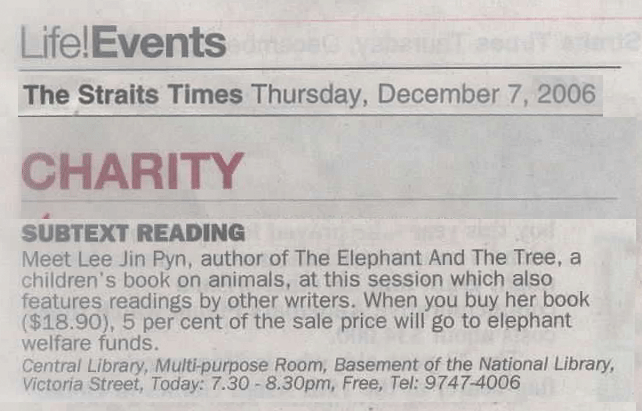
The subTEXT session on Dec 7 in the National Library was publicised by The Straits Times.
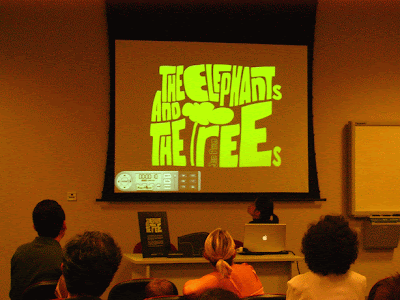
30% of the crowd, most of whom are in the literary arts scene of Singapore, bought a copy of The Elephant and the Tree as they liked the illustrations.

"A rare classic ..." The Straits Times, Dec 3
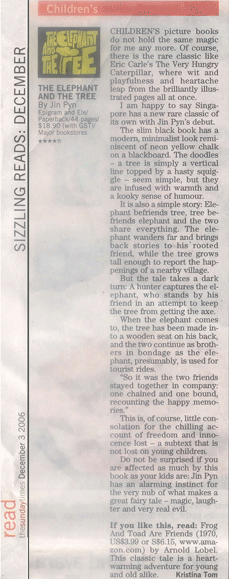
Kristina Tom of The Straits Times, the most widely read and circulated English language paper in Singapore, likened Jin Pyn's The Elephant and the Tree to Eric Carle's The Very Hungry Caterpillar - "a rare classic ... where wit and playfulness and heartache leap from the brilliantly illustrated pages all at once."
Jin Pyn is also said to have "an alarming instinct for the very nub of what makes a great fairytale - magic, laughter and very real evil."

"CHILDREN'S picture books do not hold the same magic for me anymore. Of course there is the rare classic like Eric Carle's The Very Hungry Caterpillar, where wit and playfulness and heartache leap from the brilliantly illustrated pages all at once."
I am happy to say that Singapore has a new rare classic of its own with Jin Pyn's debut.
The slim black book has a minimalist look reminiscent of neon yellow chalk on a blackboard. The doodles - a tree is simply a vertical line topped by a hasty squiggle - seem simple, but they are infuse with a warmth and kooky sense of humor."
It is also a simple story: Elephant befriends tree, tree befriends elephant and the two share everything. The elephant wanders far and bring back stories for his rooted friend, while the tree grows tall enough to report the happenings of a nearby village.
But the tale takes a dark turn. A hunter captures the elephant, who stands by his friend in an attempt to prevent his friend from getting the axe.
When the elephant comes to, the tree has been made into a wooden seat on his back, and the two continue as brothers in bondage, as the elephant, presumably, is used for tourist rides.
"So it was the two friends stayed together in company; one chained and one bound, recounting the happy memories."
This is of course, little consolation for the chilling account of freedom and innocence lost - a subtext that is not lost on young children.
Do not be surprised if you are affected by this book as much as your kids are. Jin Pyn has an alarming instinct for the very nub of what makes a great fairytale - magic, laughter, and very real evil." - Kristina Tom
Jin Pyn is also said to have "an alarming instinct for the very nub of what makes a great fairytale - magic, laughter and very real evil."
"CHILDREN'S picture books do not hold the same magic for me anymore. Of course there is the rare classic like Eric Carle's The Very Hungry Caterpillar, where wit and playfulness and heartache leap from the brilliantly illustrated pages all at once."
I am happy to say that Singapore has a new rare classic of its own with Jin Pyn's debut.
The slim black book has a minimalist look reminiscent of neon yellow chalk on a blackboard. The doodles - a tree is simply a vertical line topped by a hasty squiggle - seem simple, but they are infuse with a warmth and kooky sense of humor."
It is also a simple story: Elephant befriends tree, tree befriends elephant and the two share everything. The elephant wanders far and bring back stories for his rooted friend, while the tree grows tall enough to report the happenings of a nearby village.
But the tale takes a dark turn. A hunter captures the elephant, who stands by his friend in an attempt to prevent his friend from getting the axe.
When the elephant comes to, the tree has been made into a wooden seat on his back, and the two continue as brothers in bondage, as the elephant, presumably, is used for tourist rides.
"So it was the two friends stayed together in company; one chained and one bound, recounting the happy memories."
This is of course, little consolation for the chilling account of freedom and innocence lost - a subtext that is not lost on young children.
Do not be surprised if you are affected by this book as much as your kids are. Jin Pyn has an alarming instinct for the very nub of what makes a great fairytale - magic, laughter, and very real evil." - Kristina Tom
Subscribe to:
Posts (Atom)

